What is the disease scurvy about?
The disease scurvy is a condition characterised by general weakness, anaemia, gingivitis (gum disease), and skin haemorrhages caused by a prolonged deficiency of vitamin C (ascorbic acid) in the diet. Vitamin C plays a crucial role in the formation of collagen, a major component of connective tissue.
Humans and certain other animals require vitamin C in their diets to make the building blocks for collagen. Diagnosizs typically is based on physical signs, X-rays, and improvement after treatment.Treatment is with vitamin C supplements taken by mouth. Improvement often begins in a few days with complete recovery in a few weeks.Sources of vitamin C in the diet inclzude citrus fruits and a number of vegetables such as tomatoes.

Hypothesis
The strawberry would have the most amount of vitamin C, so strawberries would be the most suitable fruit for scurvy patients’ diet among the grapes, tomatoes and strawberries.
Experimental Design
We are going to take three different types of fruits and measure the amount of vitamin C each fruit has. We will repeat the experiment for each fruit three times.
Identifying Variables
- Independent: The number of drops of fruit juice
- Dependent: Number of drops of DCPIP
- Constant: Weight of each fruit, amount of dcpip (5 ml), amount of desallinated water (5 ml)
Materials
- Cheese cloth
- Mortar pestle
- Ceramic tile
- Butter knife
- Conical flask
- Measuring cylinder
- Plastic measuring cup
- Electric measuring scale
- Petri dish
- Dropper
Methods
Step 1: Measure and cut the fruits for each fruit to weigh the same.


Step 2: When the fruits are the same weight, grind them with a mortar and pestle. Before that, put the different fruits in different mortars and use different pestles to grind them. Mash the fruits until the fruits turn into juice.


Step 3: Measure 5 ml of desalinated water in a measuring cylinder using a dropper and then pour the desalinated water in the different mortars. Mix the desalinated water with the fruit juice.


Step 4: Pour the fruit juices into the cheesecloth to filter the residue into a measuring cup.Squeeze the cheesecloth to allow the juices to flow through the cheesecloth.


Step 5: Measure 5 ml of DCPIP and pour it into a measuring cylinder.
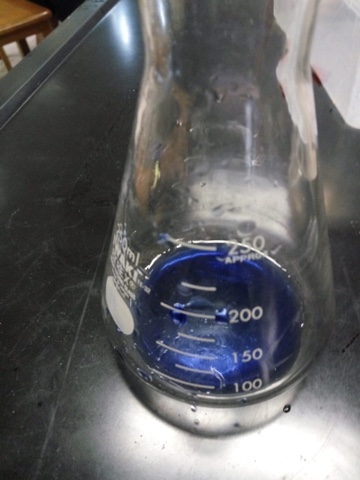
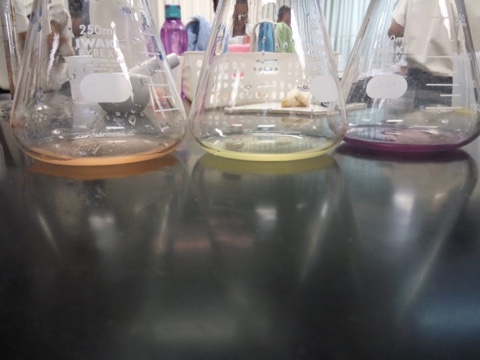
Step 6 : Use a dropper to collect the fruit juice and drip it drip by drip into the measuring cylinder with the DCPIP .After every drop of juice, shake and swirl the measuring cylinder.Repeat steps 5 and 6 with the other juices in the other two measuring cylinders with DCPIP.


Step 7: Keep dripping the juice until the DCPIP turns colourless or the colour stops changing. Count the number of drops taken to achieve that.
Result Collection and tabulation
| Try 1 | Try 2 | Try 3 | |
|
Fruits |
The number of drops of fruit juice for the DCPIP to turn clear or stop changing colour. | The number of drops of fruit juice for the DCPIP to turn clear or stop changing colour. | The number of drops of fruit juice for the DCPIP to turn clear or stop changing colour. |
|
Strawberry |
10 | 6 | 8 |
|
Grape |
12 | 9 |
14 |
| Tomato | 10 | 12 |
7 |
Results Processing
Repeat the experiment thrice and collect the results. Find the average of all three results and put it in a table. Use the gathered information to make a graph so one can understand the results easier.
Drawing a Conclusion
 Dietray Menus for scurvy patients